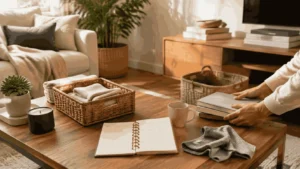
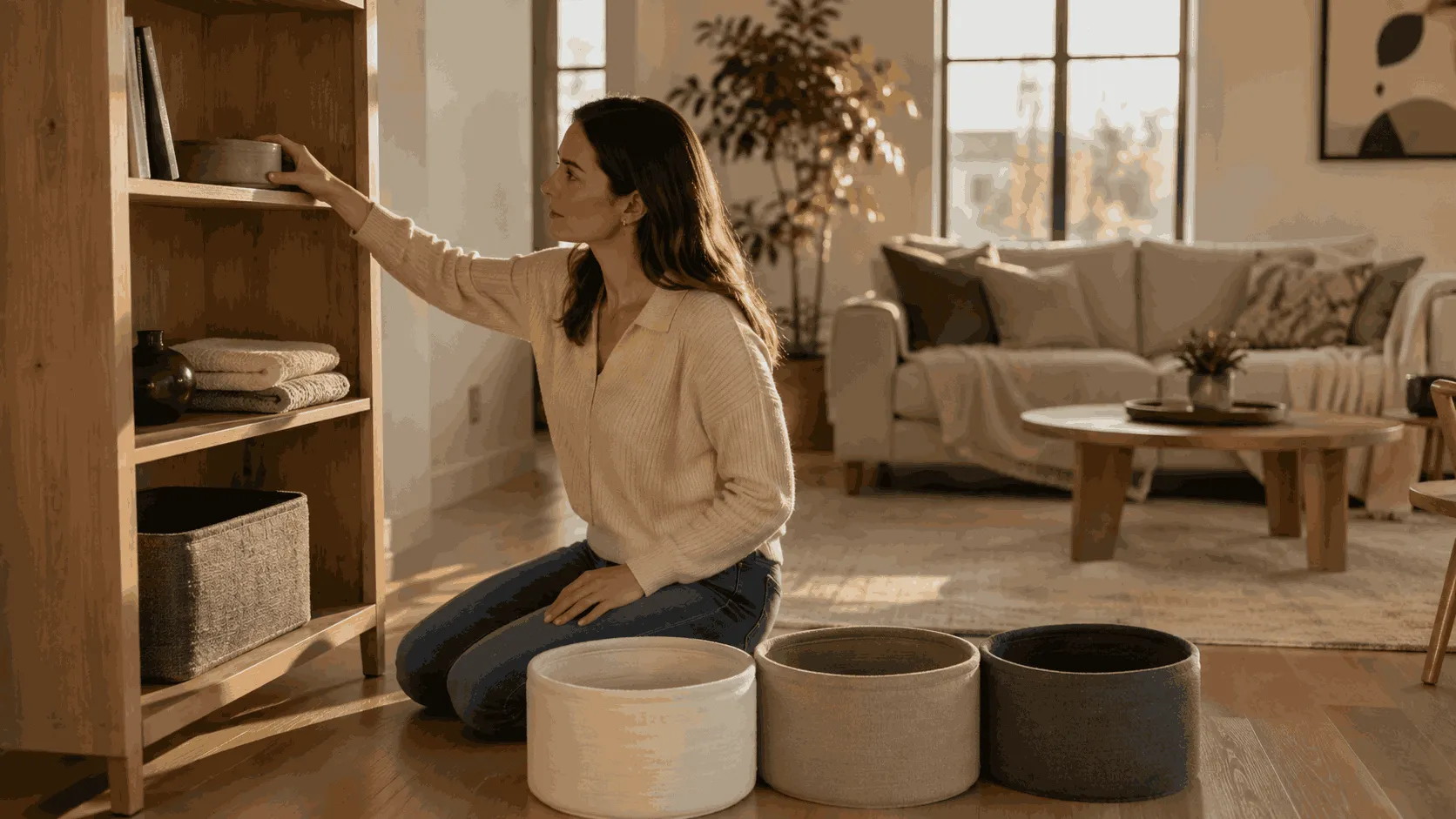
Learning how to declutter your home without feeling overwhelmed begins with making the project smaller. You do not need to empty every closet, organize every drawer, or make dozens of difficult decisions in one day.
The most effective starting point is usually one limited area: a single shelf, one kitchen drawer, a bathroom cabinet, or the surface of a desk. Completing a small space provides a visible result and prevents the rest of the home from becoming more chaotic during the process.
Decluttering is not about creating a perfect home or removing everything you own. It is about deciding which belongings support your current life and making those items easier to find, use, and return to their proper places.
Why Does Decluttering Feel So Overwhelming?
A cluttered space contains many unfinished decisions. Every object may require you to decide whether to keep it, move it, repair it, sell it, donate it, recycle it, or discard it.
When hundreds of objects are considered at once, the task becomes difficult to define. “Declutter the house” has no obvious starting point and no clear finish line.
Several common problems make the process harder:
- Starting with an area that is too large
- Removing everything from several spaces at once
- Trying to organize before reducing unnecessary items
- Making emotional decisions while tired
- Creating complicated categories
- Keeping items without assigning them a location
- Buying storage products before knowing what must be stored
- Expecting the entire home to change in one day
A manageable process reduces the number of decisions you must make at one time.
How to Declutter Your Home Without Feeling Overwhelmed
Use a simple sequence:
- Choose one small, clearly defined area.
- Set a short working period.
- Remove obvious rubbish and misplaced items.
- Sort the remaining belongings into a few categories.
- Decide what will leave the home.
- Assign a practical location to everything you keep.
- complete the removal process before starting another area.
The important principle is completion. One finished drawer is more useful than five rooms filled with unfinished sorting piles.
1. Define a Small Starting Point
Do not begin with “the bedroom” or “the kitchen.” These areas contain too many separate decisions.
Choose a physical boundary that you can understand immediately:
- One drawer
- One shelf
- One bedside table
- One section of a wardrobe
- One bathroom cabinet
- One box of papers
- One kitchen counter
- One group of similar items
A clear boundary makes progress visible. You know where to begin and when the task is complete.
Avoid starting with photographs, sentimental belongings, legal documents, or inherited items. These categories often require more time and emotional energy. Begin with a low-risk area containing objects that are easier to evaluate.
A drawer of kitchen utensils is usually a better starting point than a box of family memories.
2. Set a Realistic Time Limit
A short decluttering session is easier to begin than an open-ended project.
Set a timer for 10, 15, or 20 minutes. Choose a period short enough that you can finish even on a busy day.
The time limit has two purposes:
- It makes starting feel manageable.
- It prevents fatigue from reducing the quality of your decisions.
You can continue after the timer ends if you still have energy, but do not require yourself to do so.
The goal is not to work for as long as possible. The goal is to finish a defined area without turning the process into an exhausting event.
For larger projects, schedule several short sessions across the week rather than relying on one free weekend that may never arrive.
3. Prepare Simple Sorting Categories
Before you begin, prepare a few containers, bags, or clearly marked spaces.
Use these categories:
- Keep here
- Move elsewhere
- Donate or sell
- Recycle
- Discard
- Decide later
The “decide later” category should remain small. It prevents one difficult object from stopping the entire session, but it should not become a new permanent storage system.
Limit yourself to one small box for undecided items. Write a review date on it and reconsider those belongings after completing easier areas.
Too many categories slow the process. You do not need separate piles for every future destination while making the initial decisions.
4. Remove the Easy Items First
Begin with decisions that require little thought.
Remove:
- Empty packaging
- Broken items that cannot be repaired
- Expired products
- Obvious rubbish
- Duplicates you do not use
- Items that belong in another room
- Unwanted promotional materials
- Containers with no practical purpose
This first pass creates space and reduces visual noise. It also makes the remaining objects easier to examine.
Do not interrupt the session to carry every misplaced object to another part of the house. Place them in the “move elsewhere” container and return them after finishing the selected area.
Otherwise, one misplaced item may lead you into another room, where you discover another task and abandon the original one.
5. Ask Practical Questions About What Remains
The question “Does this bring me joy?” may work for some people, but it is not the only way to evaluate a belonging.
Use practical questions:
- Do I currently use this?
- Would I notice if it disappeared?
- Do I own another item that serves the same purpose?
- Does it fit my current home and lifestyle?
- Is it in usable condition?
- Am I keeping it because I need it or because I feel guilty?
- Would I buy this again today?
- Is the storage space it requires reasonable?
- Can I name a specific situation in which I will use it?
- Is this item difficult or expensive to replace?
No single question should decide everything. A rarely used tool may still be worth keeping if it is necessary and expensive to replace. An inexpensive item may not deserve valuable storage space if it has remained unused for years.
Judge objects according to their function, condition, replacement difficulty, and relevance to your present life.
6. Deal With Duplicate Items
Duplicates are common in kitchens, wardrobes, bathrooms, offices, and utility cupboards.
Gather similar items together so you can see the total quantity. Five individual objects stored in different places may not appear excessive until they are compared.
Keep the best examples first:
- The one in the best condition
- The one you use most often
- The size or style that works properly
- A reasonable backup, when necessary
Avoid keeping every duplicate “just in case.” Define what the backup is for and how many backups the household realistically needs.
The correct number will differ by household. Someone who cooks daily may need more kitchen tools than someone who rarely prepares food. Decluttering should support actual routines rather than impose an arbitrary minimalist standard.
7. Separate Decluttering From Organizing
Decluttering and organizing are connected but different.
Decluttering determines what stays. Organizing determines where the remaining items belong.
If you organize before reducing, you may spend money and effort creating attractive storage for objects you do not need.
Wait until you understand:
- Which items will remain
- How frequently they are used
- Where they are used
- How much space they require
- Whether existing containers already work
Only then should you consider buying organizers.
Many areas can be improved by reusing boxes, trays, jars, or dividers already available in the home. The purpose of storage is to make items accessible, not to turn every drawer into a display.
8. Give Every Kept Item a Home
An object without a designated location is likely to become clutter again.
Store belongings near where they are used. Frequently used objects should be easy to reach, while occasional items can occupy higher shelves or less convenient spaces.
A practical storage location should answer three questions:
- Where would I look for this?
- Can I access it without moving several other items?
- Can I return it easily after use?
If returning an item requires too much effort, the system may fail even if it looks organized initially.
Avoid filling storage areas completely. A drawer or shelf needs a little open space so objects can be removed and returned without rearranging everything.
Labels can help when several people share the space, but label only categories that are clear and stable. Excessive labeling can make a simple system unnecessarily complicated.
9. Remove Outgoing Items Promptly
Sorting an item into a donation bag does not remove it from the home.
Finish the process by deciding where and when each outgoing category will go:
- Put rubbish in the appropriate bin.
- Check local recycling requirements.
- Schedule a donation drop-off or collection.
- Set a deadline for selling valuable items.
- Return borrowed belongings.
- Arrange appropriate disposal for special materials.
The U.S. Environmental Protection Agency recommends reducing waste first, reusing or repairing suitable items, donating usable belongings, and checking local rules before recycling. Local programs vary, so an item marked with a recycling symbol may not necessarily be accepted in every household collection system.
Do not place batteries, electronics, paint, chemicals, or other potentially hazardous household materials in ordinary rubbish without checking local guidance. Some products require special collection or recycling arrangements.
For items you intend to sell, choose a firm deadline. If an item has not been listed or sold by that date, decide whether to reduce the price, donate it, or keep it intentionally. An indefinite “sell later” pile is still clutter.
10. Handle Sentimental Items Separately
Sentimental belongings combine physical objects with memories, relationships, and identity. Treating them like ordinary household items can make the process unnecessarily difficult.
Work on sentimental objects after building confidence with easier categories.
When reviewing them:
- Choose the items that best represent the memory.
- Keep quality rather than quantity in mind.
- Photograph an object if the memory matters more than the object itself.
- Display a meaningful item instead of hiding many similar items in storage.
- Ask whether you are preserving your own memory or someone else’s expectations.
- Avoid making permanent decisions when emotionally exhausted.
You do not have to remove an object simply because it has no practical use. Sentimental value is a legitimate reason to keep something.
The aim is to select meaningful belongings intentionally rather than allowing every associated object to remain by default.
11. Declutter Shared Spaces Fairly
Do not discard another person’s belongings without permission.
In a shared home, begin with:
- Your personal belongings
- Communal rubbish
- Items everyone agrees are unnecessary
- Shared areas where ownership is clear
Discuss the purpose of the space before debating individual objects. For example, agree that a dining table must remain clear enough for meals or that the entrance must provide safe access.
Create boundaries rather than forcing identical preferences. Each person may have a drawer, shelf, box, or section for personal items.
A shared system succeeds when everyone can understand and maintain it. A visually perfect system that only one person can operate will not remain organized.
12. Prevent Clutter From Returning
Decluttering creates space, but daily habits determine whether that space remains usable.
Use simple maintenance rules:
Complete the Journey of an Item
When you bring something into the home, decide where it belongs rather than leaving it on the nearest surface.
Use a Small Return Basket
Place one basket in a central area for objects that belong elsewhere. Empty it regularly instead of allowing items to spread across several rooms.
Reset One Surface Each Evening
Choose a frequently used surface, such as the kitchen counter, dining table, or desk. Spend a few minutes returning its contents to their designated locations.
Review Before Buying
Before purchasing an item, ask where it will be stored and whether you already own something that serves the same purpose.
Follow a Replacement Rule
For categories that accumulate quickly, consider removing a worn or unused item when a replacement enters the home.
These habits should remain simple. A maintenance system that requires excessive tracking is unlikely to last.
A Seven-Day Decluttering Plan
Use this plan to begin without disrupting the entire home.
Day 1: One Visible Surface
Clear a desk, bedside table, or section of the kitchen counter. Remove rubbish and return misplaced objects.
Day 2: One Drawer
Choose a low-emotion drawer. Group similar items and remove unused duplicates.
Day 3: Bathroom Products
Check empty, expired, or unused products. Follow local disposal instructions when a product should not enter ordinary household waste.
Day 4: Clothing
Review one category only, such as T-shirts, shoes, or coats. Do not empty the entire wardrobe.
Day 5: Paper
Gather one limited group of papers. Separate documents requiring action, permanent records, recycling, and secure destruction.
Day 6: Digital Clutter
Clear unnecessary downloads, duplicate files, unwanted screenshots, or unused applications. Back up important information before deleting it.
Day 7: Remove the Outgoing Items
Deliver donations, recycle eligible materials, discard rubbish properly, and assign locations to everything being kept.
At the end of the week, select the next seven small areas rather than trying to complete the entire home immediately.
Common Decluttering Mistakes
Emptying an Entire Room
Removing everything creates a larger mess and forces too many decisions at once. Work within a small boundary.
Buying Storage Too Early
Storage products cannot determine which belongings deserve space. Reduce first and organize second.
Creating a Large “Maybe” Pile
A small undecided box is useful. A room filled with uncertain items postpones the original problem.
Starting With Emotional Objects
Early success builds confidence. Save photographs, gifts, inherited belongings, and personal letters for later.
Keeping Items for an Imaginary Lifestyle
Keep equipment and clothing that support your current life or a specific realistic plan—not every possible future identity.
Trying to Sell Everything
Selling requires photographing, listing, communicating, and arranging delivery. Reserve this effort for belongings whose likely value justifies the time.
Expecting Permanent Perfection
Homes are used every day. The goal is not to eliminate all visible belongings but to create systems that are easy to restore.
Frequently Asked Questions
How Do I Start Decluttering When I Feel Overwhelmed?
Choose one small area that can be completed in 10 to 20 minutes, such as a drawer or shelf. Remove obvious rubbish first and avoid beginning with sentimental belongings.
What Should I Remove First?
Start with empty packaging, broken items, expired products, obvious rubbish, unused duplicates, and objects that clearly belong somewhere else.
Should I Buy Organizers Before Decluttering?
Usually, no. Decide what you are keeping before purchasing storage products. You may discover that existing containers are sufficient once unnecessary items are removed.
How Do I Decide What to Keep?
Consider whether you use the item, whether it supports your current lifestyle, its condition, storage cost, sentimental value, and how difficult it would be to replace.
What Should I Do With Items I Might Need Later?
Keep a small, dated “decide later” box. Review it after completing other areas. Avoid creating unlimited temporary storage.
How Long Should Decluttering Take?
There is no universal schedule. A series of short, completed sessions is usually more manageable than turning the entire home into one large project.
Final Thoughts
Understanding how to declutter your home without feeling overwhelmed requires changing the size of the task. Do not begin with the entire house. Begin with one space small enough to finish.
Remove easy items first, use simple categories, decide what will leave, and assign a practical location to everything you keep. Complete the removal of donations, recycling, and rubbish before starting the next area.
A functional home does not need to look empty. It needs to make everyday belongings easy to find, use, and return. Small completed decisions will produce more lasting progress than one exhausting attempt at perfection.
Sources
U.S. Environmental Protection Agency. Reduce, Reuse, Recycle.
U.S. Environmental Protection Agency. What You Can Do.
U.S. Environmental Protection Agency. How Do I Recycle Common Recyclables?.
U.S. Environmental Protection Agency. Electronics Donation and Recycling.