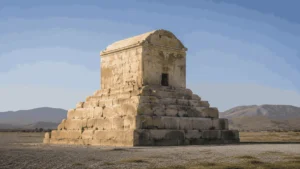

Persepolis in Iran, known locally as Takht-e Jamshid, is one of the most important archaeological sites in the Middle East. It was built by the kings of the Achaemenid Empire more than 2,500 years ago.
Today, visitors can walk among its stone stairways, tall columns, royal gateways, and detailed reliefs. These remains help us understand how Achaemenid kings presented their empire and organized an important royal center.
What Is Persepolis?
Persepolis is an ancient royal complex in Fars Province in southwestern Iran. It stands near the modern city of Marvdasht, about 60 kilometers northeast of Shiraz.
Construction began under Darius I around 518 BCE and continued under later Achaemenid kings. The complex was built on a large terrace at the foot of Kuh-e Rahmat, meaning “Mountain of Mercy.”
Persepolis included audience halls, royal palaces, administrative buildings, storage spaces, gates, stairways, and defensive structures. It was not an ordinary city made mainly of homes, shops, and streets. It was a carefully planned center connected with the Achaemenid royal court.
Persepolis at a Glance
| Fact | Information |
|---|---|
| Modern location | Near Marvdasht in Fars Province, Iran |
| Common Persian name | Takht-e Jamshid |
| Ancient name | Parsa |
| Construction began | Around 518 BCE |
| First major builder | Darius I |
| Later builders | Xerxes I, Artaxerxes I, and other Achaemenid kings |
| Main functions | Royal, ceremonial, and administrative |
| UNESCO status | World Heritage Site since 1979 |
| Present condition | Authentic archaeological ruins |
Persepolis in Iran is especially important because its monuments and administrative records provide two different views of the Achaemenid Empire. The buildings show royal power, while clay records provide evidence about workers, officials, travel, food, and administration.
What Does the Name Persepolis Mean?
Persepolis is the name most commonly used for the site outside Iran. The name came through Greek and is generally understood to mean “City of the Persians.”
The complex has three important names.
Persepolis
“Persepolis” is its standard international name. English-language books, museums, researchers, and UNESCO normally use this name.
Parsa
Parsa was the ancient name associated with the site. The name was also connected with the Persian homeland and is related to the modern name Fars.
Takht-e Jamshid
People in Iran commonly call the site Takht-e Jamshid, which means “Throne of Jamshid.”
Jamshid is a legendary king in Iranian tradition. After knowledge of the Achaemenid kings was partly lost, later generations connected the great ruins with Jamshid.
Jamshid was not the historical builder of Persepolis. The name Takht-e Jamshid belongs to the site’s later cultural history and should be separated from its documented Achaemenid history.
Who Built Persepolis?
Darius I began the main development of Persepolis around 518 BCE. His son Xerxes I and grandson Artaxerxes I continued the work. Other Achaemenid rulers later added buildings or changed parts of the complex.
Persepolis was not completed during one short construction project. Its development continued across several royal reigns.
A Simple Construction Timeline
| Period | Main development |
|---|---|
| Around 518 BCE | Darius I began the terrace and major royal buildings |
| Reign of Xerxes I | Work continued on the Apadana and other structures; the Gate of All Nations was built |
| Reign of Artaxerxes I | More buildings and royal spaces were completed |
| Later Achaemenid period | Construction and changes continued |
| 330 BCE | The complex was captured, looted, and burned during Alexander’s campaign |
Craftspeople and workers from different parts of the empire contributed to Persepolis. Its art and architecture combined knowledge from several regions, but these elements were organized into a distinctive Achaemenid royal style.
Why Was Persepolis Built?
Persepolis was a royal center where Achaemenid kings could receive visitors, hold formal gatherings, manage resources, and present the size and order of their empire.
The UNESCO World Heritage Centre describes it as a seat of government designed mainly as an important setting for royal receptions and festivals. Researchers, however, continue to discuss its exact functions and how often Achaemenid kings used it.
A popular claim says that Persepolis was built specifically for Nowruz, the Iranian New Year. A connection with royal New Year ceremonies is possible, but it has not been proved as a historical fact.
Some researchers support this interpretation. Others argue that the surviving Achaemenid evidence is not strong enough. It is therefore more accurate to describe Persepolis as a royal, ceremonial, and administrative complex rather than simply calling it a “Nowruz palace.”
What Are the Main Parts of Persepolis?
The surviving structures show how architecture, sculpture, and controlled movement worked together. Visitors entered through monumental stairways and gateways before reaching large halls and royal buildings.
The Great Stairway
A wide double stairway leads to the main terrace. Its steps are unusually low and easy to climb.
It is sometimes claimed that the stairs allowed people to ride horses onto the terrace. Strong evidence does not support this explanation. A more careful interpretation is that the low steps allowed groups of official guests to move upward slowly and comfortably.
The Gate of All Nations
The Gate of All Nations was built during the reign of Xerxes I. It formed one of the main entrances to the royal complex.
Large stone figures of winged bulls guarded its doorways. An inscription by Xerxes refers to it as the “Gate of All Lands,” commonly translated as the “Gate of All Nations.”
The gate helped control how official visitors entered and moved through the complex.

The Apadana
The Apadana was a large royal audience palace. Darius I began its construction, and Xerxes I continued the work.
Its central hall had 36 columns. More columns supported open porticoes on three sides of the building.
The carved stairways of the Apadana are among the most famous parts of Persepolis. They show guards, officials, and groups associated with different parts of the Achaemenid Empire.
The figures appear in calm and ordered processions. They are not shown fighting. These images presented an official royal vision of many peoples gathering around the Achaemenid king.

The Palace of Darius
The Palace of Darius is often called the Tachara. It was smaller than the Apadana and served as a royal palace.
Its stone doorways, stairs, and window frames have survived better than many of its walls. Large parts of the original building used mud brick and wood, which did not survive as well as stone.
The Hall of One Hundred Columns
The Hall of One Hundred Columns was one of the largest buildings at Persepolis. Its roof was supported by ten rows of ten columns.
The building is also called the Throne Hall. Its exact uses may have changed over time, but it was clearly an important royal space.
The Treasury
The Treasury stored valuable objects and also had an administrative role. Archaeologists found objects, inscriptions, and reliefs in this area.
The Treasury and the administrative records discovered at Persepolis show that the complex was more than a group of ceremonial palaces.
What Do the Persepolis Reliefs Show?
The stone reliefs are among the site’s most valuable historical features. They show royal guards, court officials, servants, horses, chariots, and groups connected with different regions of the empire.
Differences in clothing, hairstyles, objects, and animals help identify some groups. However, the reliefs should not be treated as simple photographs of daily life.
They were official works of royal art. Their purpose included communicating order, stability, and cooperation under the king.
Many figures appear calm and controlled. Their careful arrangement presents an ideal royal image of the empire rather than a complete record of its political life.
Evidence also shows that parts of the reliefs and buildings once had colour. Small traces of pigment remain on some surviving stone pieces. The original complex was therefore more colourful than the grey and brown ruins visible today.

Was Persepolis Only a Ceremonial Site?
No. Archaeological discoveries show that administrative work also took place at Persepolis.
In 1933, archaeologists from the University of Chicago found tens of thousands of clay tablets and fragments in rooms connected with the fortification wall. These records were part of an administrative system active around 500 BCE.
The Persepolis Fortification Archive includes texts and fragments written in several languages and scripts. Many were written in the Elamite language, while others used Aramaic.
The tablets recorded activities such as the storage, movement, and distribution of food. Together, they provide information about workers, officials, travellers, royal family members, languages, seals, and the organization of the empire.
These records are important because they show parts of Achaemenid society that do not appear in monumental royal art.
What Happened to Persepolis?
Alexander of Macedon captured Persepolis in 330 BCE during his campaign against the Achaemenid Empire. The complex was looted, and a major fire destroyed important wooden and mud-brick parts of its buildings.
Ancient accounts provide different explanations for the fire. Some present it as planned revenge for earlier Persian attacks on Greek cities. Others describe it as an impulsive act during a celebration.
The exact reason remains uncertain. It is safer to state that Alexander’s forces captured and burned the complex without presenting one explanation as a proven fact.
The fire did not remove every part of Persepolis. Stone columns, stairways, reliefs, door frames, inscriptions, and large sections of the terrace remained visible.
Was Persepolis Ever Completely Lost?
The ruins were never completely lost. Local communities knew the site for centuries, although people did not always understand its original Achaemenid identity.
Travellers later recorded the monuments and copied their inscriptions. The study of these inscriptions helped researchers connect the ruins with Achaemenid kings. It also contributed to the study and deciphering of Old Persian cuneiform.
Scientific archaeological work expanded during the twentieth century. University of Chicago teams led by Ernst Herzfeld and later Erich Schmidt excavated large parts of the site between 1931 and 1939. Iranian archaeologists and conservation experts continued the work afterward.
Why Is Persepolis in Iran a UNESCO World Heritage Site?
The international importance of Persepolis in Iran was formally recognized when UNESCO added the site to the World Heritage List in 1979 under criteria (i), (iii), and (vi).
UNESCO recognizes the complex for its architecture, art, construction methods, planning, and exceptional evidence of Achaemenid civilization. The protected World Heritage property covers approximately 12.5 hectares.
The surviving buildings are authentic archaeological ruins. UNESCO states that modern work at the site has not reconstructed or changed its general historic plan.
Conservation is still necessary. Weather, pollution, nearby development, and other environmental pressures can damage the stone surfaces and surrounding landscape.
What Should Visitors Notice at Persepolis?
A visit to Persepolis in Iran becomes more meaningful when visitors look beyond the size of the ruins.
Important details include:
- The ordered groups carved on the Apadana stairways
- Differences in clothing and objects among the figures
- Animal-shaped capitals at the tops of columns
- The relationship between the terrace, plain, and mountain
- Inscriptions placed near gates and royal buildings
- Marks showing how stone pieces were cut and joined
- Surviving evidence that some surfaces were once painted
The site is large and exposed. Entrance hours, ticket prices, photography restrictions, and visitor services can change. Check a current official Iranian cultural heritage source before travelling.
Visitors should not touch carvings, climb restricted structures, leave marks, or remove stones. Even small actions can permanently damage archaeological evidence.
Common Misunderstandings About Persepolis
“Persepolis was built by Jamshid.”
Jamshid belongs to Iranian legendary tradition. The documented builders were Achaemenid kings, beginning mainly with Darius I.
“The buildings always looked like bare grey stone.”
Many walls were made from mud brick, the roofs included wood, and some architectural surfaces contained colour. The modern ruins show only part of the original appearance.
“Every relief shows people bringing tribute.”
Some scenes may represent delegations carrying gifts. Other reliefs show guards, officials, servants, animals, and activities connected with the royal court. The meaning of every scene should not be simplified without evidence.
“Persepolis was certainly built for Nowruz.”
A connection with Nowruz is a well-known interpretation, not an established fact. Researchers disagree about the evidence.
“Persepolis was an ordinary capital city.”
Persepolis had royal and administrative functions, but the surviving terrace was not an ordinary urban center filled mainly with homes and markets. It was a monumental complex centered on the Achaemenid royal court.
Why Does Persepolis in Iran Still Matter?
Persepolis in Iran offers a rare view of how the Achaemenid monarchy represented a large and culturally diverse empire.
Its monuments show royal power, while its administrative tablets provide evidence about workers, officials, food systems, travel, and everyday organization. Together, these sources provide a broader picture than the palaces alone.
Persepolis is not only a symbol of ancient Iran. It is also evidence of the skills, languages, artistic traditions, and human connections that existed across the Achaemenid Empire.
Understanding the site requires care. Its surviving beauty can be appreciated without confusing legends, popular stories, and modern interpretations with verified history.
Conclusion
Persepolis in Iran, or Takht-e Jamshid, was a royal, ceremonial, and administrative center of the Achaemenid Empire. Darius I began its main development, and later kings expanded it.
Its gates, halls, columns, reliefs, inscriptions, and clay records help explain how the empire presented royal authority and managed people and resources.
Although much of the complex was damaged after its capture in 330 BCE, its authentic ruins remain among the world’s most important archaeological sites.
You can explore more guides to Iran through Ahura Media’s articles about the country’s cities, people, culture, food, and historical places.