
Introduction
The internet has become one of the most important inventions in human history. It connects billions of people, powers businesses, supports education, and enables instant communication across the globe. Today, it is difficult to imagine life without the internet, but its journey began as a small research project decades ago.
The modern internet is the result of continuous innovation, collaboration, and technological advancement. Understanding its history helps explain how a simple idea evolved into the digital infrastructure that supports much of modern society.
What Is the Internet?
The internet is a global network of interconnected computers and devices that communicate using standardized protocols. It allows users to exchange information, access websites, send messages, stream content, and perform countless other activities online.
Unlike a single system controlled by one organization, the internet is a decentralized network that spans countries, continents, and industries.
The Origins of the Internet
The foundations of the internet can be traced back to the 1960s during the Cold War era.
Researchers in the United States were exploring ways to create communication systems that could continue functioning even if parts of the network were damaged or unavailable. This led to the development of innovative networking concepts that would eventually become the internet.
One of the most important ideas was packet switching, which allowed data to be broken into smaller pieces and transmitted efficiently across networks.
ARPANET: The First Major Network
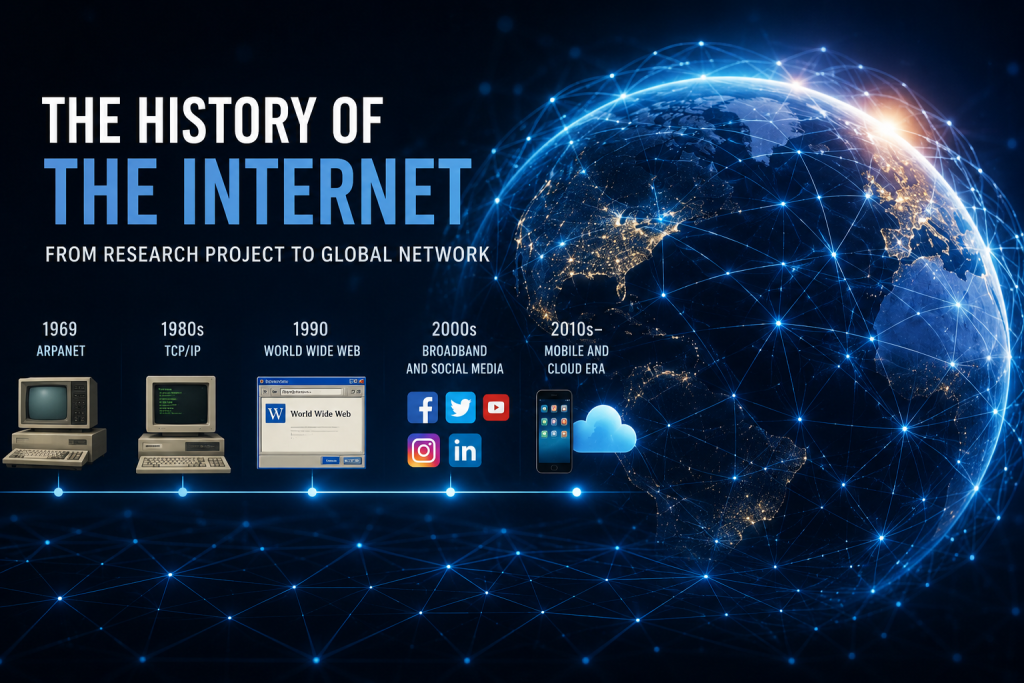
In 1969, a project known as ARPANET was launched.
ARPANET connected several research institutions and universities, allowing computers to communicate over long distances. Although limited in size, it demonstrated that networked communication was possible and practical.
The first message sent through ARPANET was a historic milestone that marked the beginning of modern computer networking.
Over time, additional institutions joined the network, expanding its capabilities and influence.
The Development of Networking Protocols
As networks grew, researchers needed common standards that would allow different systems to communicate effectively.
This challenge led to the creation of TCP/IP, a set of communication protocols that remains the foundation of the internet today.
TCP/IP enabled computers from different manufacturers and networks to exchange information using a common language.
The widespread adoption of TCP/IP in the 1980s played a critical role in the growth of the internet.
The Expansion of Academic Networks
Throughout the 1980s, universities and research organizations increasingly relied on computer networks for collaboration and information sharing.
Academic networks connected researchers across different locations, making it easier to exchange ideas and access resources.
As more institutions joined these networks, the internet’s reach expanded significantly.
The growing demand for connectivity encouraged further investment in networking technologies and infrastructure.
The Birth of the World Wide Web
A major breakthrough occurred in 1989 when the concept of the World Wide Web was introduced.
The World Wide Web made it possible to organize and access information using hyperlinks and web pages.
This innovation transformed the internet from a technical communication tool into a user-friendly platform accessible to the general public.
The first websites appeared in the early 1990s, providing a glimpse into the future of online information sharing.
The Rise of Web Browsers
The introduction of web browsers made navigating the internet easier than ever before.
Instead of using complex commands, users could access websites through graphical interfaces.
Early browsers helped popularize the web and encouraged widespread adoption among businesses, educational institutions, and consumers.
As browsers improved, the internet became more accessible and useful for everyday activities.
Commercial Growth and Public Adoption
The 1990s witnessed explosive growth in internet usage.
Businesses recognized the potential of online communication and began establishing websites to reach customers.
Internet service providers expanded access to households, allowing millions of people to connect from home.
The rise of e-commerce introduced new ways to buy and sell products online, creating entirely new industries and business models.
Search Engines and Information Discovery
As the number of websites increased, finding relevant information became more challenging.
Search engines emerged to help users navigate the growing web.
These tools indexed web pages and provided organized search results, making information easier to discover.
Search technology continues to play a central role in how people use the internet today.
The Social Media Revolution
The internet entered a new phase with the emergence of social media platforms.
Social networks transformed online communication by allowing users to create content, share experiences, and interact with others in real time.
Social media changed how people consume news, build communities, and engage with brands.
It also contributed to the rapid spread of information across global audiences.
Mobile Internet and Connectivity
The development of smartphones significantly expanded internet access.
Instead of relying solely on desktop computers, users could connect to the internet from virtually anywhere.
Mobile technology transformed communication, entertainment, navigation, shopping, and education.
Today, mobile devices account for a large percentage of internet traffic worldwide.
Cloud Computing and Modern Services
Cloud computing has become a critical component of the modern internet.
Cloud services allow businesses and individuals to store data, run applications, and access resources without maintaining expensive physical infrastructure.
Many popular online services rely on cloud technology to deliver fast, reliable experiences to users around the world.
The Internet’s Impact on Society
The internet has fundamentally changed how people live and work.
Communication
Email, messaging apps, and video calls enable instant communication across long distances.
Education
Online learning platforms provide access to knowledge and educational opportunities for millions of people.
Business
Companies use the internet for marketing, sales, customer support, and operations.
Entertainment
Streaming services, gaming platforms, and digital media have transformed entertainment consumption.
Information Access
People can access news, research, and educational resources within seconds.
Challenges Facing the Internet
Despite its many benefits, the internet also faces important challenges.
Cybersecurity
Protecting networks and users from cyber threats remains a major priority.
Privacy
The collection and use of personal data raise concerns about privacy and user rights.
Misinformation
The rapid spread of false information presents ongoing challenges for individuals and organizations.
Digital Divide
Not everyone has equal access to internet connectivity, creating disparities in opportunities and resources.
The Future of the Internet
The internet continues to evolve as new technologies emerge.
Future developments may include:
- Faster global connectivity
- Expanded use of artificial intelligence
- Smarter digital services
- Enhanced cybersecurity systems
- Greater integration of connected devices
As innovation continues, the internet will remain a powerful force shaping communication, business, education, and society.
Conclusion
From a small research network to a global digital infrastructure, the internet has transformed the world in remarkable ways. It has connected people, enabled innovation, and created opportunities that were once unimaginable.
Understanding the history of the internet provides valuable insight into how technology evolves and influences society. As the digital world continues to grow, the internet will remain at the center of communication, knowledge sharing, and technological progress for generations to come.